2616701
Albert Einstein
Scroll down to see images of the item below the description
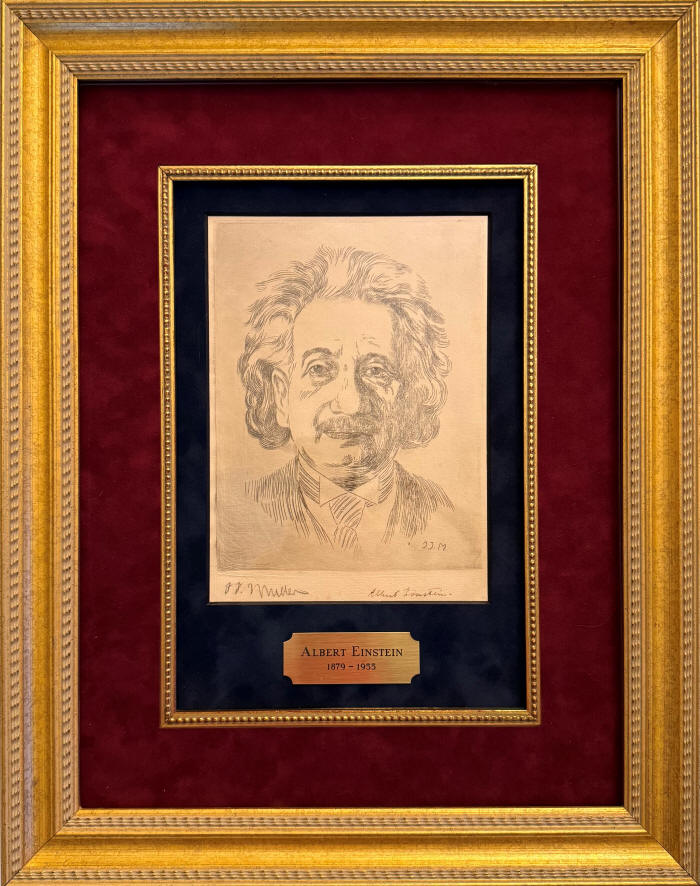
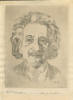
Beautifully framed 1933 etched portrait of Einstein signed by both Einstein and the artist
Albert Einstein, 1879–1955. German-born theoretical physicist. Framed portrait etching signed, Albert Einstein, and signed by the artist, J. J. Muller.
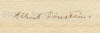
This highly desirable 1933 dry point portrait etching of Einstein is by the Hungarian-born American portrait artist J. J. Muller. Einstein has signed it in ink at the lower right. Muller has signed it in pencil in the lower left corner, and his initials are printed in the lower right corner of the printed image.
This engraving was made the year that Einstein immigrated to the United States because of the Nazi takeover in Germany and its effect on the Jewish population. Originally German, Einstein moved to Switzerland in 1895 and acquired Swiss citizenship in 1901. He reacquired German citizenship in 1917 with his move to Berlin, where he became the director of the Kaiser Wilhelm Institute for Physics. But while Einstein was visiting the United States, Adolf Hitler came to power in Germany on January 30, 1933.
In February and March, 1933, the Nazis raided Einstein’s family’s apartment in Berlin repeatedly. On March 23, 1933, the German Reichstag passed the Enabling Act, which allowed the cabinet and Hitler, as Chancellor, to enact laws without the involvement of the Reichstag—effectively making Hitler a dictator. Einstein and his wife returned to Europe in March, but when they landed in Antwerp, Belgium, on March 28, Einstein formally renounced his German citizenship by surrendering his passport at the German consulate. In April, Einstein learned that the German government had enacted laws barring Jews from holding official positions, including teaching at universities.
In May, the German Student Union, the amalgamation of student committees of all German universities, burned Einstein’s works as part its campaign to burn books that it viewed as subversive or ideologically incompatible with Nazism. Press reports said that Einstein himself was targeted for assassination and that there was a $5,000 bounty on his head. Speaking before nearly 40,000 Germans at the book burning in Berlin, Nazi Propaganda Minister Joseph Goebbels declared, “Jewish intellectualism is dead. The German soul can again express itself.”
After spending a few months in Belgium and Britain, Einstein accepted an offer from the Institute for Advanced Study in Princeton, New Jersey, to become a resident scholar. He arrived back in the United States in October 1933 and became one of the first professors at the Institute. Although he had offers from several European universities, in 1935 Einstein decided to remain permanently in the United States and to apply for American citizenship. He became an American citizen in 1940 and remained affiliated with the Institute until his death in 1955.
The artist who created this portrait of Einstein, J. J. Muller (born Isador J. Muller, 1876–1943), was a native of Budapest, Hungary. He studied at Royal Academy of Fine Arts in Munich. He and his wife immigrated to the United States in 1924, where they settled in New York City and he opened a studio near Central Park. In addition to this portrait of Einstein, he created numerous portrait paintings and etchings of personalities such as Austro-Hungarian Emperor Franz Joseph, President Franklin D. Roosevelt, New York Governor Herbert H. Lehman, Admiral Richard Byrd, aviator Wiley Post, composer, pianist, and statesman Ignacy Jan Paderewski, Wild West showmen Buffalo Bill Cody and Pawnee Bill, and scores of other prominent people. Among other places, he exhibited his portraits at the National Academy of Design in New York City. In 1935, the New York Times reported that he was “recognized as one of the foremost portrait artists in this country.”
This is a well-known portrait of Einstein, who also signed a few other prints of it. It depicts Einstein, facing forward, wearing a formal wing tip collar shirt with a jacket and tie. We believe that this one, etrched in black, is from the first print run. Our search of auction records found three signed by Einstein that have sold since 2020, including a sepia tone etching that evidently was from a later print run.
This print is in fine condition. The plate block measures 5⅞” x 7¾”, and the overall piece is approximately 6¾” x 9¼”. There is light toning along the edges of the image from prior framing, a couple of small, archivally repaired cracks along the top edge of the paper, and a tiny area of paper loss along the right edge, all of which the matting covers. See the unframed image below. Einstein’s black fountain pen signature is faded to brown but is still nicely legible. Overall, the piece is in fine condition.
The portrait is exquisitely and carefully framed. It is encased in Mylar for additional protection, double matted in claret and navy blue suede with an inlaid gold wood fillet and an engraved brass identification plate, and framed in a gilt wood frame to an overall size of 14½” x 18¾”.
Click here to see other Invention and Science and other American History items.



|