2227403
Madame Chiang Kai-shek
Scroll down to see the image of the item below the description
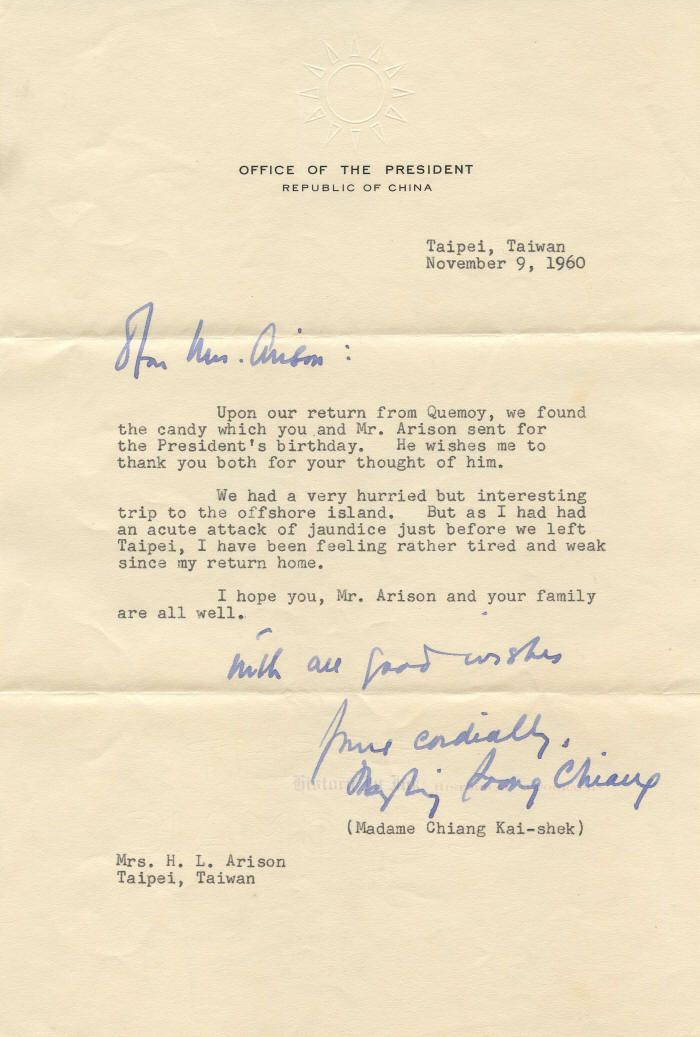
Madame Chiang sends President Chiang Kai-shek’s thanks for birthday remembrances
and discusses their trip—a dangerous one—to the embattled island of Quemoy, which both Nationalist and Communist China claim
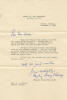
Mayling Soong Chiang, also known as Madame Chiang Kai-shek, 1898–2003. First Lady of the Republic of China, 1943–1975. Typed letter signed, Mayling Soong Chiang, with autograph emendations, one page, 7” x 10½”, on engraved, blind-embossed stationery of the Office of the President, Republic of China, Taipei, Taiwan, November 9, 1960. With original envelope.
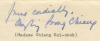
Madame Chiang writes of her trip with Nationalist Chinese President Chiang Kai-shek to the disputed island of Quemoy, just off the cost of mainland China, which both the Nationalist Chinese and Communist Chinese claimed—and still do. The island, part of a group of islands governed by Taiwan but claimed by Beijing, has been a hotbed of controversy since Communist forces bombarded the islands in 1954. Passing along Chiang’s thanks for a birthday gift, Madame Chiang writes, in full: “Upon our return from Quemoy, we found the candy which you and Mr. Arison sent for the President’s birthday. He wishes me to thank you both for your thought of him. / We had a very hurried but interesting trip to the offshore island. But as I had had an acute attack of jaundice just before we left Taipei, I have been feeling rather tired and weak since my return home. / I hope you, Mr. Arison and your family are all well.” By hand, in addition to the salutation, she adds, “With all good wishes / Yours cordially.”
On June 18–19, 1960, less than five months before Madame Chiang wrote this letter, American President Dwight D. Eisenhower visited Taiwan for meetings with Chiang Kai-shek. To “welcome” Eisenhower, the day before his arrival the army of the People’s Republic of China—the Communists—fired more than 30,000 shells at Quemoy. The People’s Liberation Army ordinarily engaged in non-lethal shelling on odd numbered days, but it resumed lethal bombardment during Eisenhower’s visit. It doubled the shelling again just after midnight. To mark Eisenhower’s departure, the Communists heavily shelled Quemoy again. Overall, they fired more than 88,000 artillery rounds at Quemoy in three attacks during Eisenhower’s visit. The Chiang government reported that the attacks killed seven Nationalist Chinese soldiers and six civilians. The wounded 59 soldiers, and 15 civilians were injured. The bombardments affected some 200 homes, five schools, and a hospital. Eisenhower and Chiang issued a joint communiqué in which their nations pledged solidarity and agreed to help each other resist Communist influence. After Eisenhower left, the Nationalist Chinese fired several thousand rounds of shells from Quemoy onto mainland China. Quemoy remained a dangerous hot spot until 1979, when the United States formally broke diplomatic ties with Taiwan in favor of ties with Communist China.
Madame Chiang writes here to Mary Jane Arison (1923–2004), the wife of U.S. Army Maj. Harold Lindsey “Lin” Arison, Jr. (1919–1998). Lin Arison was an American Army bandmaster who served as Nationalist Chinese President Chiang Kai-shek’s Military Music Advisor. The U.S. Army loaned him to the government of the Republic of China in Taipei in 1954. He organized and directed a school for music teachers, bandmasters, and instrumentalists, and he composed and arranged state ceremonial music for the government. He rearranged and harmonized the national anthem of the Republic of China, and his version remains unchanged. The Arisons were close to Chiang Kai-shek and Madame Chiang.
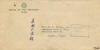
This letter is in fine condition. Madame Chiang has written the salutation and closing and has signed in blue fountain pen. The letter has a small soiling spot at the upper left edge, two horizontal folds, and scattered handling marks. The accompanying envelope has no postal markings because it was hand delivered through diplomatic channels. Chinese writing on it reads “American Embassy,” and there is the handwritten number “7366” in the lower right corner. The envelope is toned and has some stray ink marks at the top. A rubber-stamped request beside the envelope address asks Mrs. Arison to tell the driver to have a rubber stamp made with her address. Overall, the envelope is in fine condition as well.
Unframed.


|