2214515
[Edward, Duke of Windsor]
Richard N. Coudenhove-Kalergi
Scroll down to see images of the item below the description
Coudenhove-Kalergi’s book from the Windsors’ private library at La Cröe
inscribed and signed to the Duke of Windsor
just over two months after he abdicated the British throne
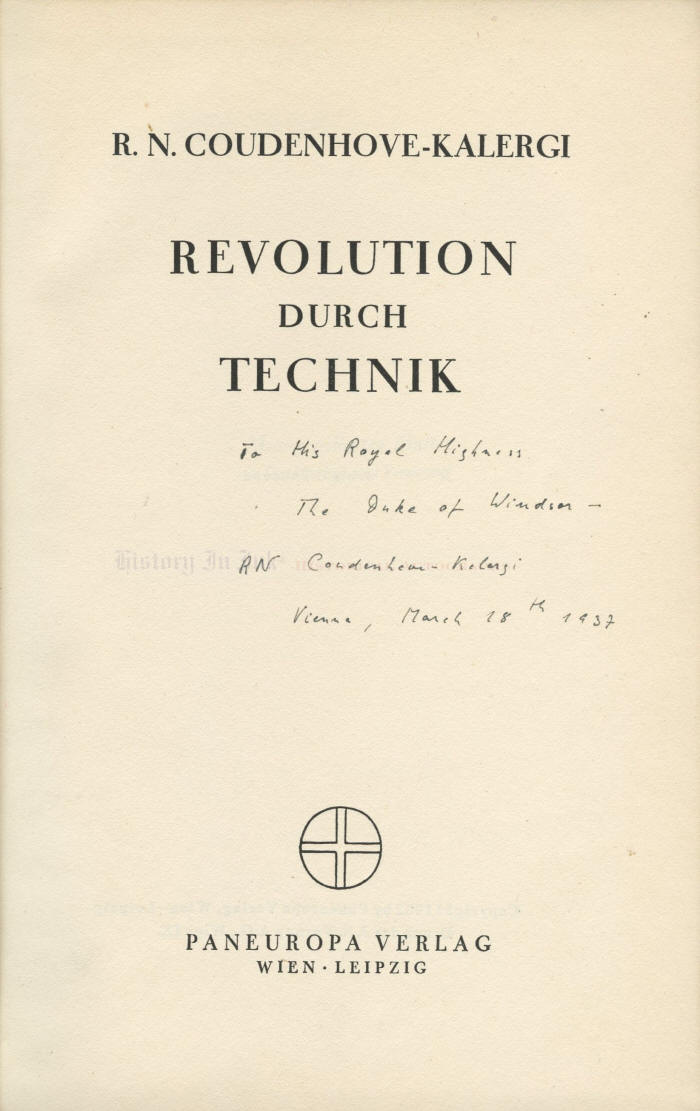
[Edward Albert Christian George Andrew Patrick David (1894–1972), King Edward VIII, 1936; Duke of Windsor, 1936–1972,] and Richard Nikolaus Eijiro, Count of Coudenhove-Kalergi (1894–1972), philosopher, politician, and founding president of the Paneuropean Union. Coudenhove-Kalergi’s book Revolution Durch Technik, inscribed and signed, R N Coudenhove-Kalergi, to the Duke of Windsor.
This book, in English Revolution Through Technology (1932), is Coudenhove-Kalergi’s twentieth book. He has inscribed and signed it “To His Royal Highness / The Duke of Windsor – / R N Coudenhove-Kalergi / Vienna March 18th 1937.” He signed it to the Duke just over two months after the Duke, then King Edward VIII, abdicated the British throne on December 10, 1936.
Coudenhove-Kalergi was an early advocate of European integration. In 1923, he published Pan-Europa, espousing the ideas that laid the foundation for the association that ultimately became the European Union in 1993. He argued in that book that “[d]ivided Europe leads to war oppression, misery; united Europe leads to peace and prosperity.” Adolf Hitler’s Nazi Party, which elevated Germans above everyone else, attacked Coudenhove-Kalergi before its rise to power in 1933. The year after he signed this book to the Duke of Windsor—who with the Duchess would famously, and controversially, tour Germany and meet with Hitler later in 1937—Coudenhove-Kalergi fled his native Austria to seek asylum in France and later in the United States. The Nazis burned all of his books published before May 1933.
In this book, written in German, Coudenhove-Kalergi argues that technology is the primary force shaping the modern world and its future. It argued that Europe’s significance lay in its technology, while Asia’s significance lay in its ethics. It argued that the “Asian spirit” posed a threat to the technological world revolution in Europe.
The Duke of Windsor was, of course, fluent in German. Interestingly, though, Coudenhove-Kalergi has inscribed it to him in English.
This appears to be the first edition of this book, which the Duke kept at the Château de la Cröe on the Cap d’Antibes peninsula of the French Riviera. The Windsors leased the château in May 1938 and lived there until June 1940, when the Germans invaded France early in World War II. The Duke and Duchess returned in 1946, after the war, and remained there until their lease expired in early 1949. The book’s final residence was in the Windsor Villa in the Bois de Boulogne in Paris, where the Windsors lived from 1953 until the Duke’s death in 1972, and where the Duchess continued to live until she died in 1986.
This book was sold at Sotheby’s New York during the auction of the Duke and Duchess of Windsors’ personal items in February 1998. It is consigned to us by a major collector who acquired it from that sale.
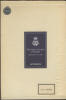
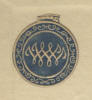
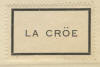
Inside the front cover are two stickers that the Windsors placed there. The Windsor cipher is in the upper left corner, and a rectangular sticker imprinted la cröe is in the lower right corner.
In between the Windsor markings is Sotheby’s sticker identifying the book as a component of the sale. It shows the original sale dates, September 11–19, 1997. The sale was postponed five months due to the untimely accidental deaths of Princess Diana of Wales and her friend Dodi Fayed in Paris on August 31, 1997. Fayed was the son of Egyptian businessman Mohammed Al-Fayed, who had substantial business interests in the United Kingdom, including Harrods department store in London. Mohammad Al-Fayed also leased the Windsor villa in the Bois de Boulogne from the City of Paris and, as a condition of the lease, refurbished and restored it. He also bought the contents of the property, including the Windsors’ library that included this book, from the principal beneficiary of the Duchess of Windsor’s estate, the Pasteur Institute. The sale comprised some 40,000 items that, in addition to the books, included the Windsors’ clothing and accessories, personal effects, photographs, and furniture, including the desk on which the Duke signed the Instrument of Abdication. Proceeds from the sale were donated to the Dodi Fayed International Charitable Foundation and causes associated with Princess Diana.
This 6” x 9” book has 101 pages, which are unmarked and exceptionally clean. In the upper right corner of the inside back cover, there is a pencil notation “W/B/1298” in an unknown hand that could be the Windsors’ stock or shelving number. The book is covered in brown cloth with faded gold foil stamping on the spine. There is no dust cover, although our research found a first-edition he lower corners are somewhat bumped, and there are cracks in the gutters inside the front and back covers. The binding is tight, however, and the text block is solid. We have no hesitation in saying that overall the book is in near fine condition. Tucked inside the book are original order forms for Coudenhove-Kalergi’s books, a membership form for the Paneuropa-Union in Austria, and various Paneuropa-Union publications.
If left and right arrows appear on your screen,
click them to scroll through the six images




|