2126004
Julian Bond
Scroll down to see images of the item below the description
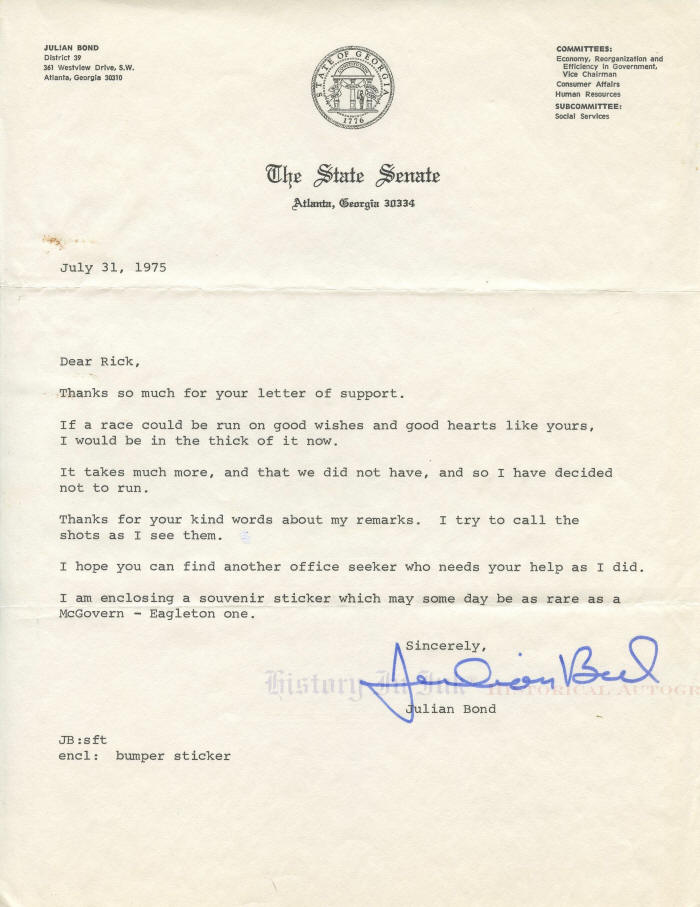
“I am enclosing a souvenir sticker which may some day
be as rare as a McGovern - Eagleton one.”
Horace Julian Bond, 1940–2015. American social activist and civil rights leader; member of the Georgia legislature, 1967–1987; chairman of the National Association for the Advancement of Colored People (NAACP), 1998–2010. Typed letter signed, Julian Bond, one page, 8½” x 11”, on stationery of The State Senate, Atlanta, Georgia, July 31, 1975.
This is an excellent letter from Bond’s short-lived campaign for the 1976 Democratic presidential nomination. Then in his first term in the Georgia Senate, and, at age 35, barely old enough to run, Bond sends thanks for support for his campaign, explains why he withdrew his candidacy, and sends one of his bumper stickers (not present) as a souvenir. He writes, in full: “Thanks so much for your letter of support. / If a race could be run on good wishes and good hearts like yours, I would be in the thick of it now. / It takes much more, and that we did not have, so I have decided not to run. / Thanks for your kind words about my remarks. I try to call the shots as I see them. / I hope you can find another office seeker who needs your help as much as I did. / I am enclosing a souvenir sticker which may some day be as rare as a McGovern - Eagleton one.”
Bond, a Democrat, briefly entered the 1976 presidential race before he withdrew on July 10, 1975, three weeks before he wrote this letter. At the end of March 1975, he said that he planned to formally announce his candidacy for the Democratic presidential nomination if, by June, he had been able to raise enough money and political support from across the country to make his candidacy worthwhile. He traveled around the country for several weeks but was unsuccessful in generating support. In announcing his withdrawal, he said, “It’s simply matter of not having money. In spite of the hundreds of people who have written expressing their support and those who worked long, hard hours trying to build a base of financial support, we just couldn’t raise enough cash.” Ultimately another Georgian, former Governor Jimmy Carter, would get the 1976 Democratic nomination and go on to win the presidency in a tight race against incumbent President Gerald R. Ford.
Bond’s statement about the potential rarity of his bumper sticker refers to the short time that Missouri Senator Thomas F. Eagleton was the vice presidential running mate with Democrat George McGovern in the 1972 presidential campaign. Eagleton was forced off the ticket, withdrawing at McGovern’s request just 19 days after he was nominated, after information about his medical past became public. In the 1960s, Eagleton had been hospitalized three times for depression and had undergone electronic shock treatment. Based on conversations with Eagleton’s doctors, McGovern decided that running with Eagleton was too big a risk. Eagleton went on to serve two more terms in the Senate.
In 1960, Bond helped found the Student Nonviolent Coordinating Committee, which coordinated and assisted challenges to segregation and the political exclusion of Black Americans. In 1965, he was elected to the Georgia House of Representatives, one of 11 Blacks elected that year. An overwhelming majority of Georgia representatives voted 184–12 to refuse to seat Bond because of his endorsement of the SNCC’s opposition to American involvement in the Vietnam War. But in a unanimous opinion by Chief Justice Earl Warren, the United States Supreme Court ruled that the Georgia House had violated Bond’s free speech rights and had to seat him. Bond v. Floyd, 385 U.S. 116 (1966). After that, Bond was elected to the George House four more times, 1967–1974, and then served six terms in the Georgia Senate, 1975–1987.
Bond led an alternative Georgia delegation to the 1968 Democratic National Convention in Chicago. He was nominated for Vice President, the first Black to be nominated for Vice President by a major party, but he declined because, at age 28, he did not satisfy the constitutional requirement that the Vice President must be at least 35 years old. Later, in 1986, Bond lost the Democratic nomination for the United States House of Representatives from Georgia’s 5th District, which includes Atlanta, to another civil rights leader, John Lewis, who then served from 1987 until his death in 2020.
In 1971, Bond helped to found the Southern Poverty Law Center, a public-interest law firm based in Montgomery, Alabama, and served as its president until 1979. In 1998, he was named chairman of the NAACP, a position he called “the most powerful job a Black man can have in America.” He served as a professor of history at the University of Virginia from 1990 to 2012, where he taught civil rights history classes that averaged 300 students.
Bond has boldly signed this letter in blue felt-tip pen The letter has normal mailing folds and shows a bit of handling. There is a small brown stain in the blank area above the date that affects nothing. The letter is in fine condition.
Unframed.


|