|
History In Ink™ Historical Autographs |
|
707505 Queen Victoria Scroll down to see images of the item below the description
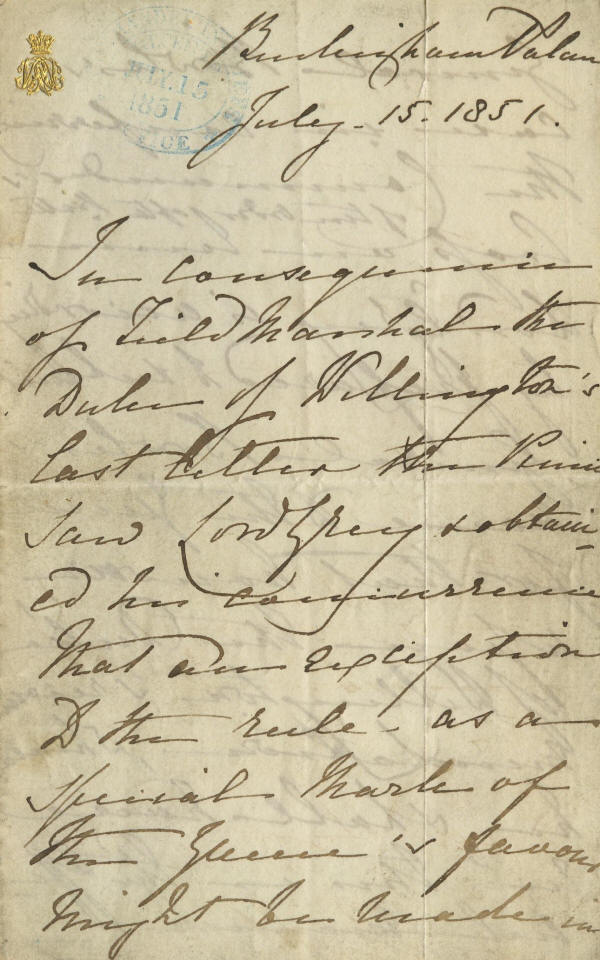
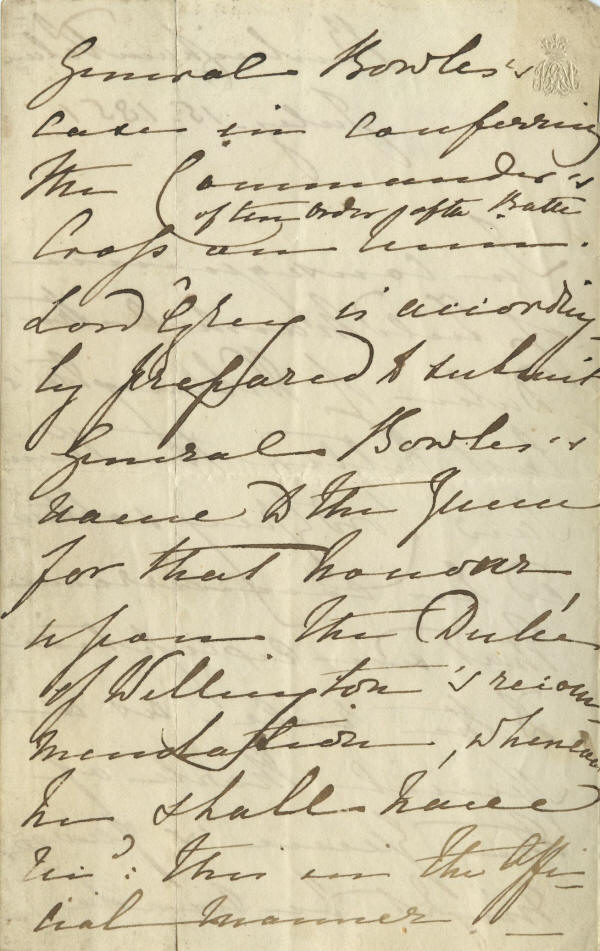
Alexandrina Victoria, 1819-1901. Queen of the United Kingdom of Great Britain and Ireland, 1837-1901. Third person Autograph Letter Signed twice in the text, the Queen, two pages (recto and verso), 4½” x 7”, with integral leaf attached, on The Queen’s gilt-embossed stationery, Buckingham Palace, July 15, 1851. This letter has an excellent association. The Queen, mentioning Prince Albert, writes to the venerable Duke of Wellington, who defeated Napoleon at Waterloo and later served as British prime minister. She seeks the recommendation of the Duke, himself holder of the Knight Grand Cross of the Order of the Bath, to make an exception in order to confer the Order upon another officer. In full: “In consequence of Field Marshal the Duke of Wellington’s last letter the Prince saw Lord Grey & obtained his concurrence that an exception to the rule as a special mark of The Queen’s favour might be reached in General Bowles’s case in conferring the Commander’s Cross of the Order of the Bath on him. Lord Grey is accordingly prepared to submit General Bowles’s name to The Queen for that honour upon the Duke of Wellington’s recommendation, whenever he shall have recd this in the official manner.” The Most Honourable Order of the Bath is the fourth most senior of the British orders of chivalry. King George I founded the Order in 1725 out of the Knights of the Bath, who drew their designation from the medieval ceremony for creating knights, one element of which was bathing as a symbol of purification. In 1847, Queen Victoria issued new statutes eliminating all references to an exclusively military Order, opening the Order to civil appointments and establishing its Military and Civil Divisions. Women became eligible for membership in 1971. The sovereign, currently Queen Elizabeth II, heads the Order, followed by the Great Master, currently Charles, Prince of Wales, and three classes of members, Knight Grand Cross or Dame Grand Cross, Knight Commander or Dame Commander, and Companion. Field Marshal Arthur Wellesley, the First Duke of Wellington (1769-1852), was widely regarded as one of the leading British military and political figures of the first half of the 19th Century. He rose to prominence during the Napoleonic Wars and ultimately commanded the British troops that defeated Napoleon at the Battle of Waterloo on June 18, 1815. He received the Order of the Bath as a result. He served as Tory prime minister 1828-1830. He was also the godfather of Queen Victoria’s seventh child, Prince Arthur, in 1850. Queen Victoria gave her name to an era. Her reign saw great industrial expansion and economic progress in Britain, but it is better known for the empire itself. Victoria was only 18 years old when she acceded to the throne upon the death of her uncle, King William IV, on June 20, 1837. She had turned 18 less than a month earlier, on May 24. She reigned for the next 63½ years until she died, at age 81, on January 22, 1901. At her death, it was said, Britain had a worldwide empire on which the sun never set. She married Prince Albert of Saxe-Coburg and Gotha in 1840. Their nine children married into many of the other royal families of Europe, including those of Denmark, Germany, and Russia. She had 42 grandchildren. Two of her grandsons were enemies during World War I: King George V ruled Britain, while Wilhelm II ruled Germany. One of her granddaughters married Nicholas II, who was deposed during the Communist revolution in Russia. Prince Albert died in 1861, and the Queen, who virtually worshiped him, suffered deep depression as a result. For the next 25 years she lived in seclusion on the Isle of Wight, in Scotland, and rarely appeared in public. The 1887 Golden Jubilee celebration of her fiftieth year of reign, however, brought her back into the public. Her popularity began to rise, and she remained popular the rest of her life. Both the Golden Jubilee and the Diamond Jubilee ten years later were marked with great displays and public ceremonies. In her later years, she became the symbol of the British Empire. Queen Victoria has boldly penned this letter. There are some soiling and wrinkling, small separations at some of the folds, and notations on the back of the integral leaf in another hand. A small corner has been cut from the integral leaf, affecting nothing. The letter is in very good to fine condition overall. Unframed. Click here to see more British royalty items on the World History page.
|
|
| $650.00 | |
|
|
|
|
home | presidents | supreme court | american history | world history | contact us |
|
|
© History In Ink, L.L.C. |
|