|
History In Ink™ Historical Autographs |
|
705804 Benjamin Harrison Scroll down to see images of the item below the description
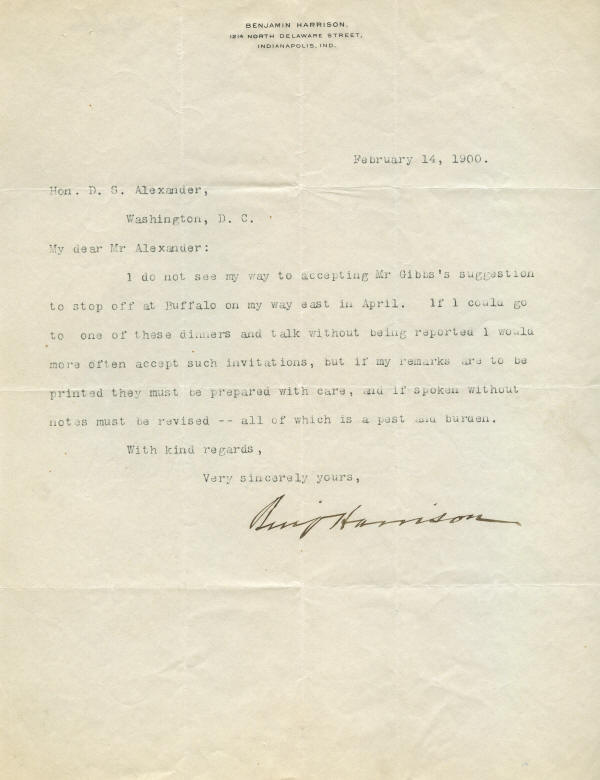
Benjamin Harrison, VI, 1833-1901. 23rd President of the United States, 1889-1893. Typed Letter Signed, Benj Harrison, one page, quarto, on personal stationery, Indianapolis, Indiana, February 14, 1900. Former President Harrison declines to attend a dinner out of concern that his might make would be quoted. In part: “If I could go to one of these dinners and talk without being reported I would more often accept such invitations, but if my remarks are to be printed they must be prepared with care, and if spoken without notes must be revised—all of which is a pest and burden.” The careful Harrison shunned extemporaneous commentary, whether in interviews or in speeches. He accepted most invitations to attend dinner functions only upon the condition that he not be required to speak or that his remarks not be reported. Harrison was the great-grandson of Virginian Benjamin Harrison, V, a signer of the Declaration of Independence, and the grandson of President William Henry Harrison, the ninth President of the United States. He was the fourth post-Civil War Republican president who had served as a general in the Union army, following Ulysses S. Grant, Rutherford B. Hayes, and James A. Garfield. Harrison was nominated for president on the eighth ballot at the 1888 Republican convention in Chicago after James G. Blaine, the party’s 1884 candidate, could not win the nomination himself and gave his support to Harrison. The Democrats nominated incumbent President Grover Cleveland. Cleveland got 90,000 more popular votes than Harrison, but Harrison won the electoral college vote 233-168. In 1892, in an historic turnaround, Cleveland defeated Harrison, who had difficulty with Republicans as well as Democrats. Harrison’s arbitrary actions, chilly personality, standoffish behavior, and refusal to take advice alienated even members of his own cabinet, and some powerful even opposed his renomination. Cleveland refused to engage in an active or personal campaign when he learned of First Lady Caroline Scott Harrison’s tuberculosis, from which she died two weeks before the election. Harrison limited himself to a few appearances in New York and New Jersey, two crucial swing states. In the end, Cleveland beat Harrison by some 375,000 popular votes. The electoral college vote outcome was more dramatic, allowing Cleveland to win by 277-145, or nearly two to one. Harrison retired to Indianapolis, where he remarried. He shunned public appearances and refused to return to politics, despite talk of renominating him for president in 1896. He did, however, accept appointment by the Venezuelan government to represent it in international arbitration against Great Britain. He died in 1901. This letter has a bold fountain pen signature by Harrison. It has normal mailing folds, one of which crosses through Harrison’s signature, light soiling, and staple holes at the upper left. It is in fine condition overall. Unframed. Please ask us about custom framing this piece.
Click here to see more presidential items.
|
|
| $450.00 | |
|
|
|
|
home | presidents | supreme court | american history | world history | contact us |
|
|
© History In Ink, L.L.C. |
|