|
History In Ink™ Historical Autographs |
|
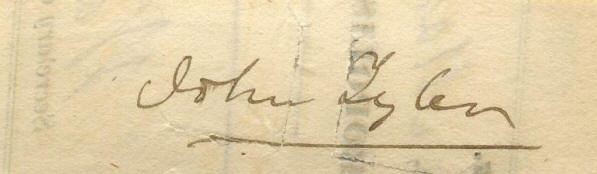
705403 John Tyler Scroll down to see images of the item below the description
John Tyler, 1790-1862. 10th President of the United States, 1841-1845. Signature, John Tyler, clipped from a document. Tyler, a lawyer, was the first Vice President to become President upon the death of his predecessor. A states’ rights Virginian, Tyler served in both the House of Representatives and the Senate. As a Senator, he reluctantly supported Andrew Jackson for the presidency but soon aligned with the Whig Party of Henry Clay and Daniel Webster to oppose him. In 1840 the Whigs, seeking to wrest southern votes from the Democrats, nominated Tyler for Vice President along with William Henry Harrison. The Whigs won, but Harrison served only one month of his term, dying of viral pneumonia on April 4, 1841. Tyler unexpectedly became the 10th President of the United States. Tyler established the protocol for presidential succession. He formally took the oath of office on April 6, 1841, and made it clear that he was President, not merely Acting President. He also delivered an inaugural address to prove his assumption of the presidency. Both houses of Congress passed resolutions recognizing him as President. Tyler’s position was finally ensconced in the Constitution with ratification of the 25th Amendment in 1967. Tyler, a strict constructionist, frustrated the Whigs. He vetoed Clay’s bill to establish a national bank with branches in several states on states’ rights grounds. The Whigs expelled Tyler from the party in retaliation. Two years later, when Tyler vetoed a tariff bill, an impeachment resolution was introduced against him in the House of Representatives, but it failed despite the report of a committee headed by Representative John Quincy Adams, himself a former President, that Tyler had misused the veto power. The most notable achievement of Tyler’s presidency was the annexation of Texas in 1845—which Tyler supported but the Whigs opposed on the ground that it would upset the political balance between North and South and might bring war with Mexico. When the Senate failed to pass an annexation treaty by the required ⅔ vote, Tyler successfully pushed both the Senate and the House of Representatives to annex Texas by joint resolution. The resolution effected the Missouri Compromise, and Tyler announced annexation on March 3, 1845, the day before he left office. Texas formally joined the union in December 1845. In February 1861, Tyler, a lifelong slaveholder, chaired the Virginia Peace Convention, which sought to avoid the Civil War. When the Senate rejected his plan, he urged Virginia to secede from the union. He served in the provisional Confederate Congress and was elected to the Confederate House of Representatives but died before he could assume office. This signature is on a slightly irregularly shaped ¾” x 2¾” slip of paper that appears to come from a financial document. The printing shows through slightly from the verso, and cancellation cuts affect the signature, as the scan below shows, so we have priced this accordingly. Otherwise the paper and signature are very nice. Unframed.
|
|
| $450.00 | |
|
|
|
|
home | presidents | supreme court | american history | world history | contact us |
|
|
© History In Ink, L.L.C. |
|