History In Ink     Historical Autographs


703401

Chester A. Arthur

Scroll down to see images of the item below the description


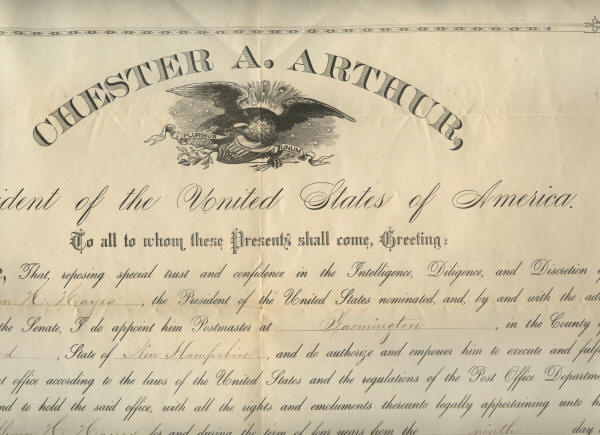
Chester Alan Arthur, 1829-1886.  21st President of the United States, 1881-1885.  14” x 17” partially printed Document Signed, Chester A. Arthur, February 24, 1885.  Countersigned by Postmaster General Frank Hatton (1846-1894).

Eight days before leaving the presidency, Arthur, “reposing special trust and confidence in the Intelligence, Diligence, and Discretion of William H. Hayes,” appoints Hayes postmaster at Farmington, New Hampshire. 

Arthur showed just how the presidency can turn a politician into a statesman.  He took office a partisan, patronage politician, but as president he supported the Pendleton Civil Service Act that outlawed salary kickbacks from public employees, prevented their termination for political reasons, and established a bipartisan Civil Service Commission to administer competitive examinations for federal jobs.  Arthur’s biographer, Thomas Reeves, wrote that Arthur underwent a “genuine transformation from a spoils-hungry, no-holds barred Conkling henchman into a restrained, dignified Chief Executive.”

Arthur, a Republican political leader, helped to secure the nomination of Ulysses S. Grant in 1868.  President Grant subsequently appointed Arthur, a lawyer and former New York Quartermaster General during the Civil War, to be the Collector of Customs in the New York Custom House.  Arthur oversaw the movement of goods into New York, collected duties and fines, and regulated businesses.  One of his major responsibilities was to give Republican supporters patronage jobs. Employees, in turn, had to donate part of their income to the party.

In 1878, President Rutherford B. Hayes fired Arthur, claiming that Arthur, whose ties to New York’s corrupt political machine were well known, had used tax money to reward political supporters.  The charges were never proven, though, and that set the stage for the 1880 Republican convention.  With the convention deadlocked between Grant and Maine Senator James G. Blaine, the delegates compromised and nominated Ohio Senator James A. Garfield on the 36th ballot. To mollify the Stalwart faction of the party, the convention nominated Arthur for Vice President.

On July 2, 1881, a disappointed office seeker shot Garfield, who died on September 19.  Arthur became President.

Arthur grew in the office.  In addition to supporting the Pendleton Civil Service Act, he ordered the Attorney General to prosecute a series of Post Office Department fraud cases involving many of Arthur’s friends and associates, appointed a commission to examine the issue of high tariffs, promoted tariff reform, and modernized the Navy.  But Arthur paid a high political price.  His position on patronagethe spoils systemalienated his supporters and left the Republican Party in disarray.  Arthur was virtually a President without a party.

 Because of ill health, Arthur did not actively seek the Republican nomination in 1884.  The party nominated Blaine, whom Arthur immediately endorsed.  Blaine lost the election to Grover Cleveland, and Arthur returned to New York City.  He practiced law until he died of a massive cerebral hemorrhage on November 18, 1886.

Arthur has boldly signed this document with a beautiful 4½” fountain pen signature.  The gold foil seal of the Post Office Department, with its red ribbon, is intact.  The document has mailing folds and two minute, virtually unnoticeable pinholes where folds cross. It is in fine to very fine condition overall. 

Unframed.    Please ask us about custom framing this piece.


Click here to see more Presidents items that we are offering.

$975.00

ORDER THIS ITEM

We could not scan this entire document because of its size.

These scans accurately show its quality condition.

.


home  |  presidents  |  supreme court  |  american history  |  world history  |  contact us

© History In Ink, L.L.C.

Registered Dealer # RD281