605330
Hugo L. Black
Scroll down to see images of the items below the description
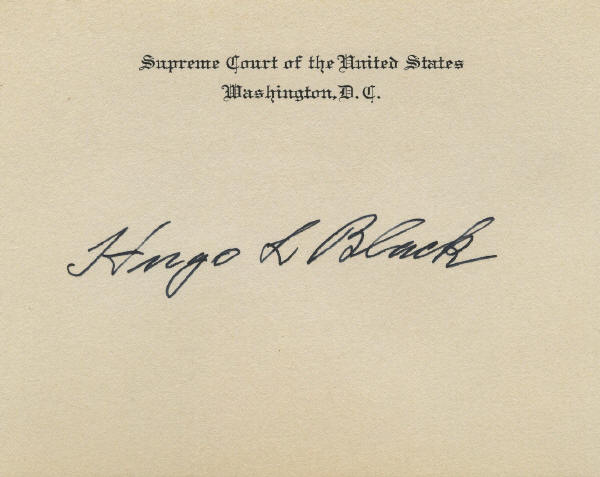
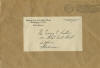
Hugo Lafayette Black, 1886-1971. Senator from Alabama, 1927-1937; Associate Justice, United States Supreme Court, 1937-1971. Vintage card engraved ”Supreme Court of the United States, Washington, D.C.,” boldly signed, Hugo L. Black. With original mailing envelope.
Black, a Democrat, was elected to the United States Senate in 1926 and reelected in 1932. In the Senate he strongly supported the New Deal policies of President Franklin D. Roosevelt, including FDR's infamous Court-packing plan. It therefore was not surprising that Roosevelt made Black his first appointment to the Supreme Court. Apoplectic conservatives expressed outrage, but FDR reveled over the furor.
The Senate confirmed Black's appointment to the Supreme Court on August 17, 1937, and he took his seat as an Associate Justice on October 4, 1937. In between, Black found himself embroiled in controversy. Newspapers reported that he had been a member of the Ku Klux Klan. After returning from a short trip to Europe, Black delivered a national radio address explaining his reasons for joining, but soon resigning from, the Klan. In time the controversy subsided.
One of the Court's most forceful personalities, Black was seen by some—notably Justices Felix Frankfurter and Robert H. Jackson—as a bully who acted more like a legislator than a judge. Although Frankfurter walked a careful line, Jackson, who despised Black, did not. Jackson, a close friend of Roosevelt, thought himself in line to be the next Chief Justice when Harlan Fiske Stone died in 1946. But President Harry S. Truman instead appointed his longtime friend, Fred M. Vinson. Jackson, who was in Germany serving as a prosecutor at the Nuremberg war crimes trials, issued a caustic public statement accusing Black of meddling with the President's choice.
As a Justice, Black was an absolutist on the First Amendment's guarantee of free speech. The constitutional directive that "Congress shall make no law" abridging the freedom of speech, Black insisted, meant just that. Black was often labeled an "activist" because of his willingness to review legislation that arguably violated constitutional provisions. His philosophical debate with Frankfurter and, later, John Marshall Harlan lasted throughout his career on the bench.
Black served until his resigned on September 17, 1971, following a debilitating stroke. He died just eight days later on September 25, 1971.
This card is in very fine condition. We would describe it as extra fine were it not for a paper clip impression at the upper left that is virtually imperceptible and indeed does not show in the enlarged scan below. Justice Black has signed with a beautiful black fountain pen signature. The accompanying mailing envelope is in fine condition. It has been opened at the flap but not cut or torn, and some of the unused glue is still present. It is addressed in another hand and bears a February 8, 1949, postmark.
Unframed. Please ask us about custom framing this piece.
Click here to see more Supreme Court items.


|