605317
Louis D. Brandeis
Scroll down to see images of the item below the description
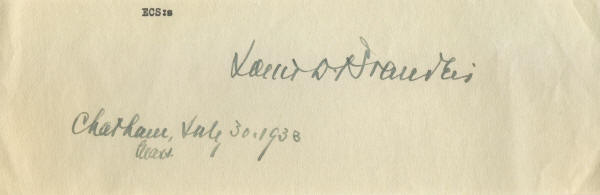
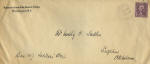
Louis Dembitz Brandeis, 1856-1941. Associate Justice, United States Supreme Court, 1916-1939. Beautiful fountain pen signature, Louis D. Brandeis, dated in Brandeis's hand, Chatham, Mass., July 30, 1938, on the bottom portion of a letter that has been removed from the letter itself. With the original engraved Supreme Court mailing envelope addressed in Brandeis's hand.
Brandeis sent this autograph to Oklahoma lawyer Ewing C. Sadler on the bottom of Sadler's letter. Sadler's initials and the initial of his typist appear on the sheet, which measures 3" x 8½".
The son of Jewish immigrants, Brandeis was born and raised in Louisville, Kentucky. He went to Germany to complete his secondary education but returned to the United States to enter Harvard Law School at age 19. He graduated in 1877 with the highest grade average in the law school's history.
Brandeis began practicing law in St. Louis, but within a year he returned to Boston to practice with his classmate Samuel Warren. He developed outstanding credentials as a lawyer. A reformer interested in freeing government from corruption and in making democratic government a reality, Brandeis saw the law as a tool to shape social, economic, and political affairs. Accordingly, he spent much of his time pursuing cases with a political bent. He represented the public interest in a number of controversial cases, often without pay.
Brandeis was also an ardent Zionist. He became active in Zionist affairs during World War I, chairing the Provisional Executive Committee for General Zionist Affairs. Brandeis had a major impact on the American branch of the Zionist movement.
In 1916, President Woodrow Wilson made Brandeis his second Supreme Court appointment. Despite Brandeis’s considerable abilities, the appointment was very controversial. A five-man subcommittee of the Senate Judiciary Committee heard testimony concerning his "fitness" to serve. Former President William Howard Taft and six former presidents of the American Bar Association signed a letter urging rejection of the nomination on ground that Brandeis was unfit. The president of Harvard and other Boston Brahmins also wrote to urge rejection of the nomination. The subcommittee split 3-2, along party lines, to approve the nomination. Ultimately, after substantial politicking by the Wilson Administration, the Judiciary Committee sent the to the full Senate by another party-line vote, 10-8. The Senate confirmed Brandeis 47-22.
As a Justice, Brandeis remained a reformer, favoring small government and state experimentation. His constitutional outlook was progressive, anti-monopolist, and anti-big business. He mastered procedural details, researched the facts and the law, and went to great lengths to fashion opinions that were clear and logical. Although no longer an official of the Zionist movement, he worked behind the scenes to influence President Wilson to support the Zionist cause, led a delegation of American Zionists to a conference in London, and later appealed to President Franklin D. Roosevelt to oppose the British plan to partition Palestine in 1937.
Brandeis has boldly penned these pieces in his distinctive hand. The sheet bearing his signature is in very fine condition, slightly irregularly trimmed at the top and showing a bit of handling. The envelope is toned and wrinkled in the corners but overall is in fine condition.
Unframed.
This item is sold.


|