|
History In Ink™ Historical Autographs |
|
529213 Matthew B. Ridgway Scroll down to see images of the item below the description
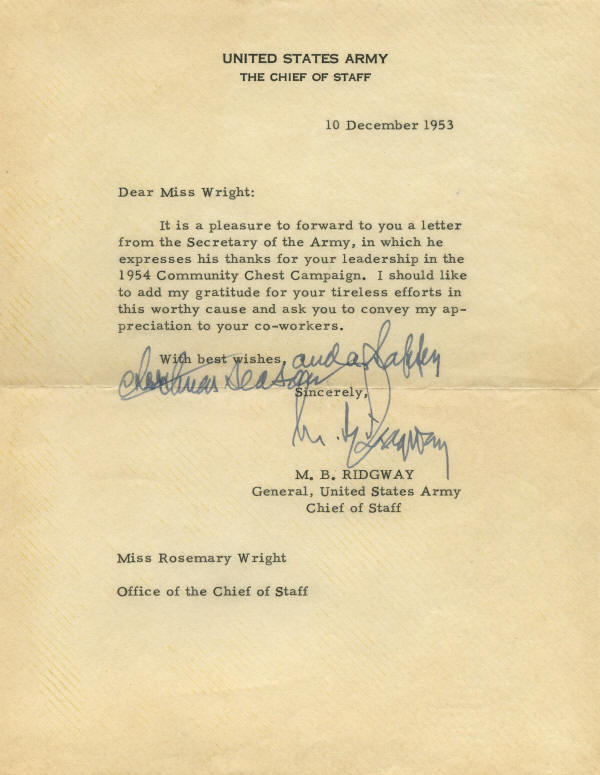
Matthew Bunker Ridgway, 1895-1993. United States Army general; commander of United Nations forces in Korea; NATO Supreme Commander. Typed Letter Signed, M. B. Ridgway, with autograph annotation, one page, 7” x 9”, on stationery of the United States Army, Office of the Chief of Staff, no place [Washington, D.C.], December 10, 1953. Ridgway thanks staff member Rosemary Wright and her colleagues for their fundraising efforts. He writes: “It is a pleasure to forward you a letter from the Secretary of the Army, in which he expresses his thanks for your leadership in the 1954 Community Chest Campaign. I should like to add my gratitude for your tireless efforts in this worthy cause and ask you to convey my appreciation to your co-workers.” He adds “With best wishes” and, in handwriting, “and a happy Christmas season”. Rosemary E. Wright (1890-1969) spent some 35 years working for the Army, ultimately as Chief of the Army General Staff Assignment Section, before she retired in November 1953. Miss Wright handled all of the administrative work relating to officers assigned to the General Staff. She knew all of them—well enough to call Eisenhower “Ike,” George S. Patton, Jr., “Georgie,” and Jonathan Wainwright “Skinny.” She wrote of her years with the Army in The Generals Call Me “Mom,” which appeared in the March 15, 1952, edition of Collier’s magazine. A highly decorated soldier, Ridgway gained prominence in World War II. He helped to plan the invasion of Sicily in 1943, leading the 82nd Airborne Division, which he helped to create, in the invasion. The next year, on June 6, 1994, he parachuted with his troops into Normandy as a leading element of the allied D-Day invasion. Later he was given command of the 18th Corps, which he led in the Battle of the Bulge and on into Germany. In Korea, Ridgway assumed command of the U.S. Eighth Army during the Chinese offensive late in 1950. Always one to seek the offensive himself, Ridgway took control of the ground war, restoring the morale of his troops and halting the Communist advance. He retook Seoul and pushed north to the 38th Parallel, the dividing line between North and South Korea. When President Harry S. Truman relieved General Douglas MacArthur of command, he named Ridgway to replace him. Ridgway thus became supreme commander for the Allied Powers in Japan, commander of United Nations forces in Korea, and commander of all United States forces in the Far East. Ridgway served for a short time as the Supreme Allied Commander in Europe in 1952. In October 1953, shortly before Ridgway wrote this letter, his predecessor, by then President Dwight D. Eisenhower, appointed him Army Chief of Staff. He held that position until he retired from active duty in 1955. He advocated reliance on conventional, rather than nuclear, capability and consistently criticized American involvement in Vietnam. Ridgway’s many military decorations included the Distinguished Service Cross, the Distinguished Service Medal, the Legion of Merit, and the Silver Star. He received the Presidential Medal of Freedom from President Ronald Reagan in 1986 and the Congressional Gold Medal in 1991. Ridgway has boldly annotated and signed this letter. The letter has slight staining from previous mounting in a photo album but overall is in fine condition. Unframed.
Click here and scroll down to see other American military items.
|
|
| $75.00 | |
|
|
|
|
home | presidents | supreme court | american history | world history | contact us |
|
|
© History In Ink, L.L.C. |
|